
Baldness: causes, types and solutions that work
Baldness affects half of all men and nearly half of all women. Understanding the causes is the first step – choosing the right solution is the one that changes everything.
What is baldness and how common is it?
Baldness (medically: alopecia) is a condition in which hair is lost permanently and does not grow back. What separates it from everyday shedding – everyone loses 50 to 100 hairs a day – is permanence: with baldness, hair follicles gradually weaken, shrink and finally die.
The most common form is androgenetic alopecia, which affects roughly half of all men by age 50, while around 40% of women experience noticeable thinning by menopause. Baldness is neither rare nor a reason for shame – but it is a reason to know your options.
Male pattern baldness (androgenetic alopecia)
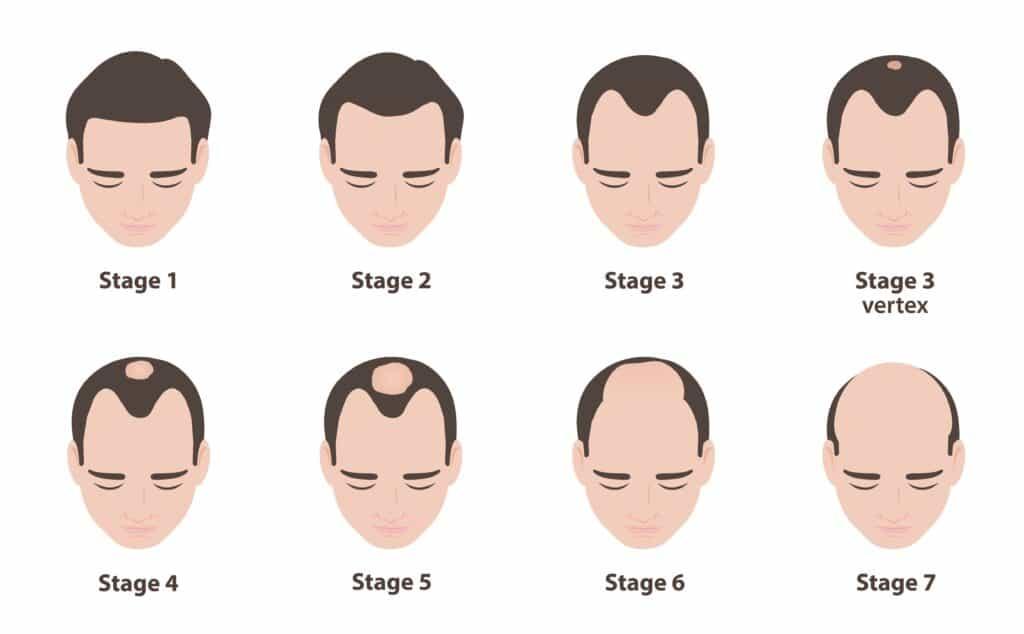
In men, baldness is caused by an increased sensitivity of hair follicles to the hormone DHT. It progressively shortens the hair growth phase: hairs become thinner and shorter until the follicle dies. The typical pattern starts with a receding hairline, continues with crown thinning and can progress to complete baldness of the top of the head.
The progression is measured on the seven-stage Norwood-Hamilton scale. The higher the stage, the smaller the chance of success with medication or transplant – which is why the solution should match your stage, not advertising promises.
Female pattern baldness
Female baldness progresses differently. The hairline is usually preserved while hair thins diffusely – evenly – across the crown. Progression is measured on the three-stage Ludwig scale: from barely noticeable thinning to a widening part to visible scalp.
Because the thinning is gradual and diffuse, women often only notice it after a third of their hair is gone. Triggers include hormonal changes (pregnancy, menopause, thyroid), stress, iron deficiency and genetics. Solutions that add density without surgery are especially suitable: hair toppers, hybrid systems and natural-hair wigs.
The most common causes of baldness
Genetics and hormones. Inherited DHT sensitivity accounts for over 90% of male baldness and much of female baldness. It can be inherited from either parent.
Stress and traumatic events. Severe stress can trigger telogen effluvium – accelerated shedding a few months after the event. Usually temporary, though chronic stress can entrench thinning.
Autoimmune causes (alopecia areata). The immune system attacks its own hair follicles, causing hair to fall out in round patches. It can progress to complete loss of scalp or body hair.
Chemotherapy and medication. Cytostatics, anticoagulants, some antidepressants and blood-pressure drugs can cause extensive hair loss – hair mostly grows back after therapy ends.
Iron and nutrient deficiency. Low iron stores (ferritin), protein, zinc or vitamin D deficiency weaken hair growth. A blood test is a sensible first step for unexplained shedding.
Thyroid conditions. Both an overactive and an underactive thyroid often show first in the hair – it becomes thin, brittle and sparse.
Solutions for baldness – an honest comparison
No solution is best for everyone – the right choice depends on your stage of baldness, health, budget and expectations. An honest comparison:
Medication (minoxidil, finasteride)
Works only in early stages and only while you use it. It can slow shedding but rarely restores lost hair. Finasteride can have hormonal side effects.
Hair transplant
Surgical relocation of your own follicles. Effective at lower stages, but requires a sufficient donor area – often not feasible with advanced baldness. Results take 12–18 months.
Wig
An immediate solution for full coverage, especially suitable during chemotherapy and extensive female hair loss. A quality European-hair wig looks natural and feels comfortable.
More about wigs →Hybrid system
A combination of hair-system technology and a European-hair wig – more natural than a classic wig at a more accessible price, in stock and quickly available.
More about hybrid systems →Hollywood Hair System®
A custom-made transparent micro-mesh with hand-knotted natural hair. Full, natural hair without surgery – even at the highest stages of baldness when a transplant is no longer possible. Continuous wear, 6-month warranty.
Discover the Hair System® →Frequently asked questions about baldness
Is baldness hereditary?
Yes, the most common form of baldness – androgenetic alopecia – is largely hereditary. What is inherited is an increased sensitivity of hair follicles to the hormone DHT, which progressively shortens the hair growth phase. The predisposition can be passed down from either parent.
Can baldness be stopped or cured?
Minoxidil and finasteride can slow down or temporarily halt hair loss for some people, but they only work while you keep using them. Where hair follicles have already died, hair does not grow back. For advanced baldness the realistic solutions are a hair transplant, a hair system or a wig.
When does male pattern baldness start?
Male pattern baldness can begin soon after the age of 18, most often with a receding hairline and thinning at the crown. By the age of 50, roughly half of all men experience noticeable baldness.
What is the best solution for advanced baldness?
In advanced baldness (higher Norwood-Hamilton stages) a hair transplant is often no longer possible because the donor area is insufficient. A hair system is then the best non-invasive solution – it delivers full, natural-looking hair within weeks, without surgery.
Does baldness affect women too?
Yes. By menopause roughly 40% of women experience noticeable hair thinning. Female pattern hair loss is usually diffuse – hair thins evenly across the crown (Ludwig scale). Solutions include hair toppers, hybrid systems and natural-hair wigs.
Not sure which solution is right for you?
In a free, discreet consultation at our studio in Kranj we review your scalp and options together – with no obligation.
Book a free consultation